Can AI Replace Mobile Application Developers? A Realistic Look at the Future
Feb 24, 2026
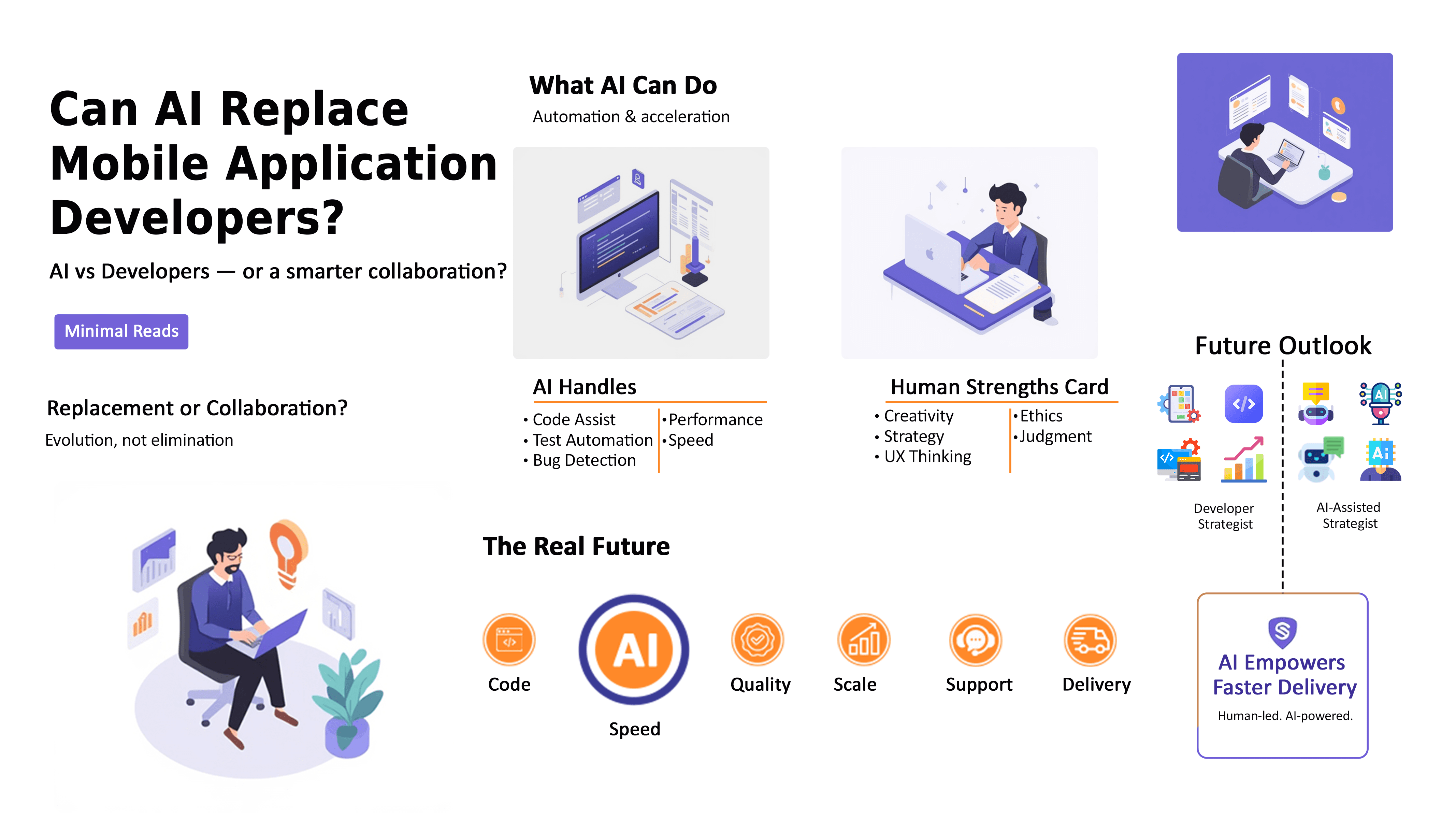
When you hear people talk about AI writing entire apps with a prompt like “Build my app,” the thought of mobile developers being replaced feels almost inevitable. Headlines proclaim that AI will soon eliminate developer jobs, and experiments like automated code generation are undeniably impressive. But when we dig deeper into how AI is actually being used in mobile app development — from UX to testing to production deployment — the story becomes more nuanced. Instead of replacement, what we’re seeing is evolution, augmentation, and a redefinition of roles.
The Role of AI in Mobile App Development
AI has already become an integral part of the mobile development workflow. It influences multiple phases of building an app:
Automated Code Generation
Tools like GitHub Copilot, Amazon CodeWhisperer, and others can generate functions, boilerplate, or even UI elements based on natural language prompts. This speeds up development and reduces repetitive work.
Intelligent Testing and QA
AI-powered testing platforms can automatically generate test suites, identify bugs, and simulate edge cases that might otherwise slip through manual testing.
Enhanced UX and Personalization
AI can analyze user behavior to suggest tailored experiences, recommend features, or optimize app interfaces for engagement — something no template or algorithm alone could reliably do before.
Security and Performance Monitoring
Machine learning models can detect unusual app behavior in real time, helping to flag security vulnerabilities, performance bottlenecks, or abnormal user interactions.
These innovations aren’t future predictions — they’re happening now. Developers adopting these tools are reporting faster turnaround times, higher productivity, and fewer manual bottlenecks.
But do these advances mean AI can fully replace developers? Not quite.
What AI Can Do in Mobile Development
AI excels at tasks that are:
Repetitive (e.g., boilerplate code and test generation)
Pattern-based (e.g., suggesting code completions or detecting vulnerabilities)
Data-driven (e.g., analytics, personalization, and predictive models)
In other words, AI is already very good at doing the “grunt work” — the parts of development that don’t require strategic thinking or deep contextual understanding. These include:
Scaffolding project structures
Creating basic UI layouts
Drafting standard CRUD operations
Generating unit test templates
Highlighting syntax errors or common bugs
This dramatically speeds up the pace of development and allows human developers to focus on higher-value contributions. But these efficiency gains do not equate to full automation of the development process.
The Hybrid Reality: AI as Developer’s Co-Pilot
So if AI is not replacing mobile developers, what is it doing?
Augmenting their work.
Developers are increasingly using AI assistants to:
Speed up repetitive tasks
Generate first drafts of code or design
Help brainstorm solutions
Automate testing and QA
Optimize performance and security workflows
In practice, AI tools act like highly productive teammates — not replacements.
This hybrid model reshapes roles:
Developers who embrace AI focus on creative solutions, architecture, user experience, and strategy.
AI handles automation, suggestions, and optimization.
In fact, industry leaders now emphasize this model. A developer who uses AI effectively can outperform one who does not — not because the AI replaces them, but because it amplifies their output.
How Mobile Developer Roles Will Evolve
Mobile development won’t go away — it will transform. Developers of the future will blend deep technical skills with AI fluency. Key areas of focus will include:
AI Integration
Innovators will embed predictive models, recommendation engines, and intelligent automation inside mobile apps.
Prompt Engineering
Developers will need to write prompts that guide AI to generate meaningful code — not just accept outputs blindly.
UX Strategy
Designing meaningful user journeys, accessibility adaptations, and emotional experiences will remain human-led.
AI Ethics & Security
Understanding the risks of AI-generated code or personalized models will become a core part of a developer’s responsibility.
Market & Product Vision
Developers will increasingly act as product thinkers and technical strategists rather than just coders
Future Outlook: Collaboration, Not Replacement
So will AI replace mobile developers? The answer is no — at least not completely or imminently. Instead, AI is reshaping workflows and creating new opportunities for developers to do more impactful work.
The future of mobile app development is best described as collaborative:
AI handles repetitive tasks and standard code generation
Developers focus on vision, user needs, architecture, and innovation
This shift means developers who embrace AI will thrive — and those who don’t may find themselves left behind.
In the long run, developers won’t disappear — they’ll become more strategic, more creative, and more focused on solving real-world problems with human insight.
AI Empowers, Not Replaces, Mobile Developers
AI is powerful and changing quickly. It is already transforming mobile app development. However, it cannot replace the creativity, empathy, and judgment that human developers provide. AI is not the end of developers. Instead, it marks the beginning of a new era in which humans and machines collaborate. Together, they can create smarter and more impactful mobile applications.
When you hear people talk about AI writing entire apps with a prompt like “Build my app,” the thought of mobile developers being replaced feels almost inevitable. Headlines proclaim that AI will soon eliminate developer jobs, and experiments like automated code generation are undeniably impressive. But when we dig deeper into how AI is actually being used in mobile app development — from UX to testing to production deployment — the story becomes more nuanced. Instead of replacement, what we’re seeing is evolution, augmentation, and a redefinition of roles.
The Role of AI in Mobile App Development
AI has already become an integral part of the mobile development workflow. It influences multiple phases of building an app:
Automated Code Generation
Tools like GitHub Copilot, Amazon CodeWhisperer, and others can generate functions, boilerplate, or even UI elements based on natural language prompts. This speeds up development and reduces repetitive work.
Intelligent Testing and QA
AI-powered testing platforms can automatically generate test suites, identify bugs, and simulate edge cases that might otherwise slip through manual testing.
Enhanced UX and Personalization
AI can analyze user behavior to suggest tailored experiences, recommend features, or optimize app interfaces for engagement — something no template or algorithm alone could reliably do before.
Security and Performance Monitoring
Machine learning models can detect unusual app behavior in real time, helping to flag security vulnerabilities, performance bottlenecks, or abnormal user interactions.
These innovations aren’t future predictions — they’re happening now. Developers adopting these tools are reporting faster turnaround times, higher productivity, and fewer manual bottlenecks.
But do these advances mean AI can fully replace developers? Not quite.
What AI Can Do in Mobile Development
AI excels at tasks that are:
Repetitive (e.g., boilerplate code and test generation)
Pattern-based (e.g., suggesting code completions or detecting vulnerabilities)
Data-driven (e.g., analytics, personalization, and predictive models)
In other words, AI is already very good at doing the “grunt work” — the parts of development that don’t require strategic thinking or deep contextual understanding. These include:
Scaffolding project structures
Creating basic UI layouts
Drafting standard CRUD operations
Generating unit test templates
Highlighting syntax errors or common bugs
This dramatically speeds up the pace of development and allows human developers to focus on higher-value contributions. But these efficiency gains do not equate to full automation of the development process.
The Hybrid Reality: AI as Developer’s Co-Pilot
So if AI is not replacing mobile developers, what is it doing?
Augmenting their work.
Developers are increasingly using AI assistants to:
Speed up repetitive tasks
Generate first drafts of code or design
Help brainstorm solutions
Automate testing and QA
Optimize performance and security workflows
In practice, AI tools act like highly productive teammates — not replacements.
This hybrid model reshapes roles:
Developers who embrace AI focus on creative solutions, architecture, user experience, and strategy.
AI handles automation, suggestions, and optimization.
In fact, industry leaders now emphasize this model. A developer who uses AI effectively can outperform one who does not — not because the AI replaces them, but because it amplifies their output.
How Mobile Developer Roles Will Evolve
Mobile development won’t go away — it will transform. Developers of the future will blend deep technical skills with AI fluency. Key areas of focus will include:
AI Integration
Innovators will embed predictive models, recommendation engines, and intelligent automation inside mobile apps.
Prompt Engineering
Developers will need to write prompts that guide AI to generate meaningful code — not just accept outputs blindly.
UX Strategy
Designing meaningful user journeys, accessibility adaptations, and emotional experiences will remain human-led.
AI Ethics & Security
Understanding the risks of AI-generated code or personalized models will become a core part of a developer’s responsibility.
Market & Product Vision
Developers will increasingly act as product thinkers and technical strategists rather than just coders
Future Outlook: Collaboration, Not Replacement
So will AI replace mobile developers? The answer is no — at least not completely or imminently. Instead, AI is reshaping workflows and creating new opportunities for developers to do more impactful work.
The future of mobile app development is best described as collaborative:
AI handles repetitive tasks and standard code generation
Developers focus on vision, user needs, architecture, and innovation
This shift means developers who embrace AI will thrive — and those who don’t may find themselves left behind.
In the long run, developers won’t disappear — they’ll become more strategic, more creative, and more focused on solving real-world problems with human insight.
AI Empowers, Not Replaces, Mobile Developers
AI is powerful and changing quickly. It is already transforming mobile app development. However, it cannot replace the creativity, empathy, and judgment that human developers provide. AI is not the end of developers. Instead, it marks the beginning of a new era in which humans and machines collaborate. Together, they can create smarter and more impactful mobile applications.
Don't hesitate to contact us.
Grow Your Business With Us!
Reach out to us, and let's turn your vision into reality!
ADDRESS
8330 Lyndon B Johnson Fwy,
Dallas, TX 75243
© 2017 - 2026 Bilions. All rights reserved.
Don't hesitate to contact us.
Grow Your Business With Us!
Reach out to us, and let's turn your vision into reality!
ADDRESS
8330 Lyndon B Johnson Fwy,
Dallas, TX 75243
© 2017 - 2026 Bilions. All rights reserved.
Don't hesitate to contact us.
Grow Your Business With Us!
Reach out to us, and let's turn your vision into reality!
ADDRESS
8330 Lyndon B Johnson Fwy,
Dallas, TX 75243
© 2017 - 2026 Bilions. All rights reserved.