Autonomous AI Agents: The Next Era of IT Innovation
Nov 25, 2025
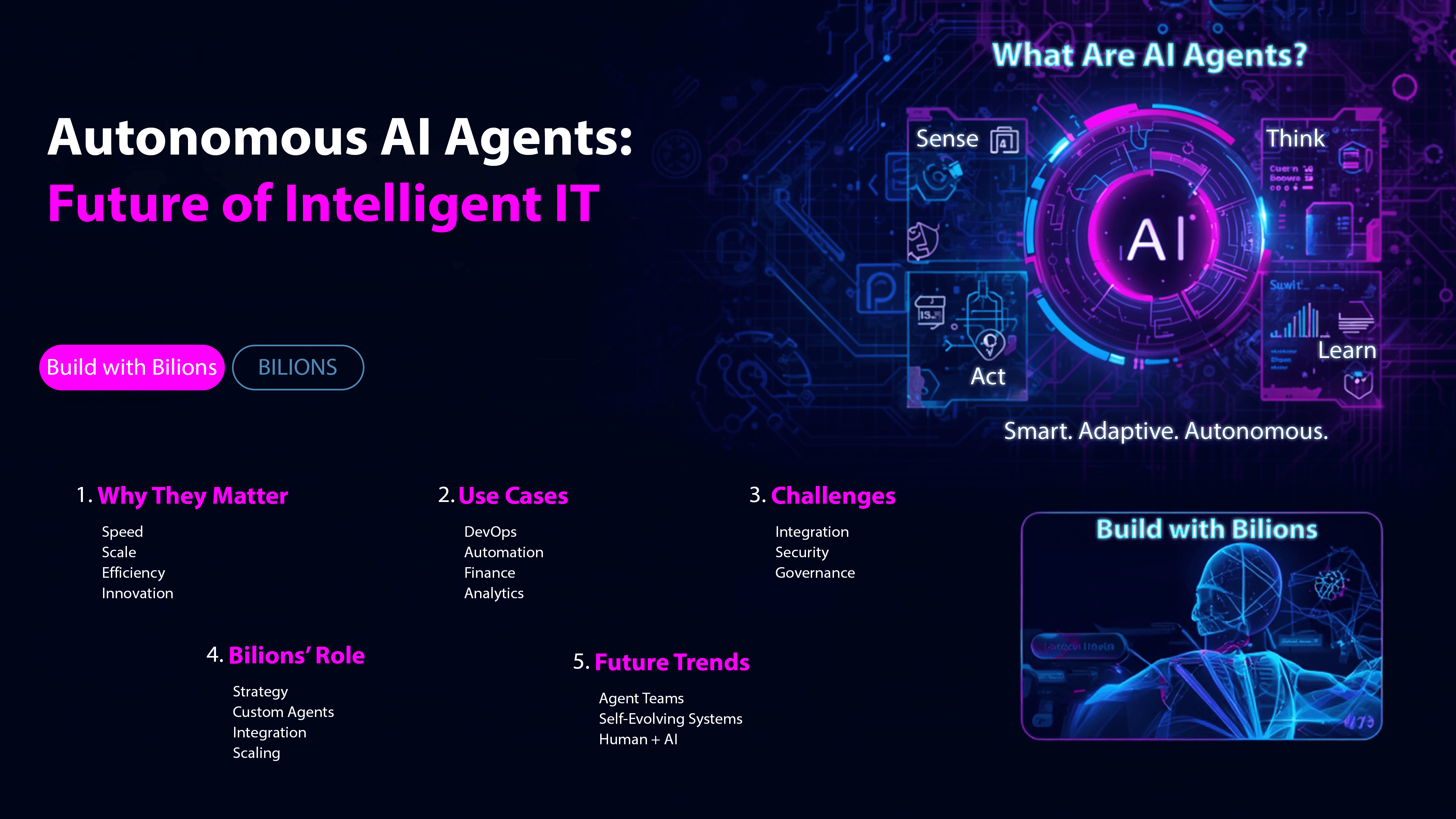
In today’s fast-moving IT landscape, we’re witnessing a profound shift: traditional automation is evolving into something far more potent — the advent of autonomous AI agents. What were once rule-based scripts or guided bots are now independent systems that perceive, reason, act and learn. These agents are transforming how IT operations, software engineering, business workflows and entire enterprise systems function. In this post, we’ll explore how autonomous AI agents are reshaping IT, why they matter, how industries are adopting them — and how service providers like Bilions are enabling this future.
What are Autonomous AI Agents?
At their core, autonomous AI agents are intelligent systems programmed to operate with minimal human intervention: they sense environments, assess data, make decisions, and execute actions toward specific goals. As defined by the term “agentic AI”, these systems differ from traditional automation by being proactive, adaptive and ongoing.
“Autonomous AI agents are changing how users interact with software and do business in almost every sector of the economy.”
In short: autonomous AI agents = software that acts, learns, adapts, repeats — not just triggering on fixed rules but evolving with data and context.
Why This Matters for the Future of IT
The significance of autonomous AI agents in IT cannot be overstated. Here are major reasons:
Enhanced Efficiency and Productivity
These agents automate not just repetitive tasks but entire decision loops: perception → reasoning → action → feedback. This capability is highlighted in how agents are now used in software development. AI agents that can detect bugs, generate code, integrate with CI/CD pipelines and learn from patterns.Scalability of Complex Workflows
Traditional automation struggles as systems grow in complexity and unpredictability; autonomous agents excel because they can adjust to changing data, inputs and outcomes.
Driving Innovation & Competitive Advantage
When IT operations become smarter and faster, companies reap benefits: quicker time-to-market, better quality, deeper insights. Agents help companies stay ahead of competition by increasing output, lowering costs and accelerating operations.Shift from Human-Monitored to Human-Augmented
We’re moving from systems where humans control every step to systems where humans monitor higher-level outcomes, and agents run routine end-to-end workflows. This frees IT and development teams to focus on innovation rather than manual orchestration.Real-World Impact: Use Cases Across IT & Business
Let’s look at how autonomous AI agents are being applied across IT and business functions:
Software Engineering & DevOps
Agents now assist in requirement analysis, code generation, bug detection, automated testing, deployment and production monitoring. AI agents are revolutionizing software reports precisely this “perception-reasoning-action” cycle being applied to the SDLC.Back-Office IT & Workflow Automation
For large enterprises, autonomous agents are replacing manual workflows in HR, procurement, supply chain and operations. The concept of “multi-agent teams” (specialized AI workers collaborating) is gaining ground.Finance, Banking, Compliance
Autonomous agents in finance streamline back-office operations, drive personalized customer interactions, and enforce compliance in real-time. Also, agents are being used in billing, accounts receivable, invoice parsing and debt collection workflows.Decision Support & Analytics
Autonomous agents can ingest large volumes of structured and unstructured data, identify patterns, make suggestions or actions — for example in financial reporting, risk management, regulatory documentation,
These use cases illustrate: autonomous AI agents are not a niche “chatbot” improvement. They’re foundational for the next era of intelligent IT systems.
Challenges & What to Look Out For
Adoption isn’t without hurdles. Some key challenges:
Integration Complexity
Embedding agent-based systems into legacy IT, data pipelines and enterprise workflows can be non-trivial. Integration is one of the biggest technical challenges for AI agents today.Interpretability & Trust
As agents decide and act autonomously, it becomes critical to ensure transparency, explainability and control.Ethical, Security & Governance Concerns
Autonomous systems must comply with data privacy, regulatory requirements, bias mitigation and ensure they don’t create unintended risk. AI emphasizes enterprise-grade security in its financial services agents.Process Quality and Maintenance
Simply automating a bad process doesn’t yield results. One article notes: “Bad processes that have been automated are still bad processes … in a world of autonomous agents process flows must be understandable.”
Despite these challenges, the momentum and business case for autonomous AI agents are too strong to ignore.
How Bilions Helps You Capitalise on This Shift
Enter Bilions — a full-service AI development partner well-positioned to guide organisations through this wave of autonomous agent adoption.
With Bilions’ AI development services, you can:
Explore use-case discovery: Identify which workflows, systems or business functions stand to benefit from autonomous agents.
Engage in custom agent design & development: Build agent architectures tailored to your data, systems, goals and compliance needs.
Ensure toolchain & integration support: Connect agents with your IT ecosystem, likely including cloud, data platforms, security frameworks.
Plan for deployment, scaling & monitoring: Go beyond proof-of-concept to production-ready autonomous systems that evolve over time.
Receive ongoing governance, optimization & performance engineering: Make sure your agents continue to deliver ROI, learn and adapt.
For organisations eager to move from “automation” to “autonomy”, Bilions offers a trusted path — from strategy through to live agent ecosystems. This aligns seamlessly with the broader industry trends that emphasise agile, scalable and intelligent agents as the heart of next-gen IT.
Looking Ahead: What’s the Future?
The next era of IT innovation will be defined by autonomous AI agents playing a central role in enterprises. A few forward-looking trends:
Agentic ecosystems: Instead of a single agent, entire networks or teams of agents — collaborating and orchestrating workflows across departments.
Closed-loop development & operation: Agents monitoring production, learning from incidents, generating code or patches, deploying fixes, and feeding back into models — in effect a self-evolving SDLC.
Mixed-human and agent collaboration: Humans focusing on strategy and oversight; agents handling execution and optimization.
Cross-industry diffusion: Beyond IT and finance, agents will penetrate healthcare, retail, logistics, smart cities and more — anywhere complex workflows exist.
Ethical and explainable agent ecosystems: With autonomy comes responsibility — expect more emphasis on governance, interpretability, auditability and trust.
For IT leaders, software teams and organisations of all sizes, the message is clear: autonomous AI agents are not “nice to have” — they are becoming fundamental.
Final Thoughts
In conclusion, autonomous AI agents represent a major inflection point in how we conceive IT, workflows, software systems and organisational operations. They’re shifting the paradigm from human-driven, manual oversight to intelligence-driven, self-acting systems. The business implications are vast: faster innovation, lower cost, better scale, smarter decision-making.
But realising that future demands strategic planning, robust architecture and expert execution. That’s where partners like Bilions become essential. If you’re ready to unlock the potential of autonomous AI agents and drive your organisation into the next era of IT innovation — now is the time to act.
In today’s fast-moving IT landscape, we’re witnessing a profound shift: traditional automation is evolving into something far more potent — the advent of autonomous AI agents. What were once rule-based scripts or guided bots are now independent systems that perceive, reason, act and learn. These agents are transforming how IT operations, software engineering, business workflows and entire enterprise systems function. In this post, we’ll explore how autonomous AI agents are reshaping IT, why they matter, how industries are adopting them — and how service providers like Bilions are enabling this future.
What are Autonomous AI Agents?
At their core, autonomous AI agents are intelligent systems programmed to operate with minimal human intervention: they sense environments, assess data, make decisions, and execute actions toward specific goals. As defined by the term “agentic AI”, these systems differ from traditional automation by being proactive, adaptive and ongoing.
“Autonomous AI agents are changing how users interact with software and do business in almost every sector of the economy.”
In short: autonomous AI agents = software that acts, learns, adapts, repeats — not just triggering on fixed rules but evolving with data and context.
Why This Matters for the Future of IT
The significance of autonomous AI agents in IT cannot be overstated. Here are major reasons:
Enhanced Efficiency and Productivity
These agents automate not just repetitive tasks but entire decision loops: perception → reasoning → action → feedback. This capability is highlighted in how agents are now used in software development. AI agents that can detect bugs, generate code, integrate with CI/CD pipelines and learn from patterns.Scalability of Complex Workflows
Traditional automation struggles as systems grow in complexity and unpredictability; autonomous agents excel because they can adjust to changing data, inputs and outcomes.
Driving Innovation & Competitive Advantage
When IT operations become smarter and faster, companies reap benefits: quicker time-to-market, better quality, deeper insights. Agents help companies stay ahead of competition by increasing output, lowering costs and accelerating operations.Shift from Human-Monitored to Human-Augmented
We’re moving from systems where humans control every step to systems where humans monitor higher-level outcomes, and agents run routine end-to-end workflows. This frees IT and development teams to focus on innovation rather than manual orchestration.Real-World Impact: Use Cases Across IT & Business
Let’s look at how autonomous AI agents are being applied across IT and business functions:
Software Engineering & DevOps
Agents now assist in requirement analysis, code generation, bug detection, automated testing, deployment and production monitoring. AI agents are revolutionizing software reports precisely this “perception-reasoning-action” cycle being applied to the SDLC.Back-Office IT & Workflow Automation
For large enterprises, autonomous agents are replacing manual workflows in HR, procurement, supply chain and operations. The concept of “multi-agent teams” (specialized AI workers collaborating) is gaining ground.Finance, Banking, Compliance
Autonomous agents in finance streamline back-office operations, drive personalized customer interactions, and enforce compliance in real-time. Also, agents are being used in billing, accounts receivable, invoice parsing and debt collection workflows.Decision Support & Analytics
Autonomous agents can ingest large volumes of structured and unstructured data, identify patterns, make suggestions or actions — for example in financial reporting, risk management, regulatory documentation,
These use cases illustrate: autonomous AI agents are not a niche “chatbot” improvement. They’re foundational for the next era of intelligent IT systems.
Challenges & What to Look Out For
Adoption isn’t without hurdles. Some key challenges:
Integration Complexity
Embedding agent-based systems into legacy IT, data pipelines and enterprise workflows can be non-trivial. Integration is one of the biggest technical challenges for AI agents today.Interpretability & Trust
As agents decide and act autonomously, it becomes critical to ensure transparency, explainability and control.Ethical, Security & Governance Concerns
Autonomous systems must comply with data privacy, regulatory requirements, bias mitigation and ensure they don’t create unintended risk. AI emphasizes enterprise-grade security in its financial services agents.Process Quality and Maintenance
Simply automating a bad process doesn’t yield results. One article notes: “Bad processes that have been automated are still bad processes … in a world of autonomous agents process flows must be understandable.”
Despite these challenges, the momentum and business case for autonomous AI agents are too strong to ignore.
How Bilions Helps You Capitalise on This Shift
Enter Bilions — a full-service AI development partner well-positioned to guide organisations through this wave of autonomous agent adoption.
With Bilions’ AI development services, you can:
Explore use-case discovery: Identify which workflows, systems or business functions stand to benefit from autonomous agents.
Engage in custom agent design & development: Build agent architectures tailored to your data, systems, goals and compliance needs.
Ensure toolchain & integration support: Connect agents with your IT ecosystem, likely including cloud, data platforms, security frameworks.
Plan for deployment, scaling & monitoring: Go beyond proof-of-concept to production-ready autonomous systems that evolve over time.
Receive ongoing governance, optimization & performance engineering: Make sure your agents continue to deliver ROI, learn and adapt.
For organisations eager to move from “automation” to “autonomy”, Bilions offers a trusted path — from strategy through to live agent ecosystems. This aligns seamlessly with the broader industry trends that emphasise agile, scalable and intelligent agents as the heart of next-gen IT.
Looking Ahead: What’s the Future?
The next era of IT innovation will be defined by autonomous AI agents playing a central role in enterprises. A few forward-looking trends:
Agentic ecosystems: Instead of a single agent, entire networks or teams of agents — collaborating and orchestrating workflows across departments.
Closed-loop development & operation: Agents monitoring production, learning from incidents, generating code or patches, deploying fixes, and feeding back into models — in effect a self-evolving SDLC.
Mixed-human and agent collaboration: Humans focusing on strategy and oversight; agents handling execution and optimization.
Cross-industry diffusion: Beyond IT and finance, agents will penetrate healthcare, retail, logistics, smart cities and more — anywhere complex workflows exist.
Ethical and explainable agent ecosystems: With autonomy comes responsibility — expect more emphasis on governance, interpretability, auditability and trust.
For IT leaders, software teams and organisations of all sizes, the message is clear: autonomous AI agents are not “nice to have” — they are becoming fundamental.
Final Thoughts
In conclusion, autonomous AI agents represent a major inflection point in how we conceive IT, workflows, software systems and organisational operations. They’re shifting the paradigm from human-driven, manual oversight to intelligence-driven, self-acting systems. The business implications are vast: faster innovation, lower cost, better scale, smarter decision-making.
But realising that future demands strategic planning, robust architecture and expert execution. That’s where partners like Bilions become essential. If you’re ready to unlock the potential of autonomous AI agents and drive your organisation into the next era of IT innovation — now is the time to act.
Don't hesitate to contact us.
Grow Your Business With Us!
Reach out to us, and let's turn your vision into reality!
ADDRESS
8330 Lyndon B Johnson Fwy,
Dallas, TX 75243
© 2017 - 2026 Bilions. All rights reserved.
Don't hesitate to contact us.
Grow Your Business With Us!
Reach out to us, and let's turn your vision into reality!
ADDRESS
8330 Lyndon B Johnson Fwy,
Dallas, TX 75243
© 2017 - 2026 Bilions. All rights reserved.
Don't hesitate to contact us.
Grow Your Business With Us!
Reach out to us, and let's turn your vision into reality!
ADDRESS
8330 Lyndon B Johnson Fwy,
Dallas, TX 75243
© 2017 - 2026 Bilions. All rights reserved.